6 Billion Ways presents…

Taking back our economy: Making it work for the 99%

An evening of short films and speakers

Tuesday 31 January, 6.30pm. Rich Mix, 35-47 Bethnal Green Road, London E1

Three years after the collapse of Lehman Brothers, governments are squeezing communities to ensure business as usual for an increasingly feral elite. Fresh questions are being raised: Are we in need of better policies and stricter financial regulation? Or do we need an entirely new economic system?

We’re seeing threats of widespread financial collapse and public sector cuts in the UK and across Europe, home repossessions, record levels of unemployment, yet ever-higher wages for corporate executives, declining tax receipts by the rich, booming city profits and deepening inequality. Ordinary people are asking: Is it time to build an alternative, sustainable economy that really serves our interests?

Amid the rise of strikes and resistance everywhere and the growing global Occupy Movement, 6 Billion Ways is hosting an evening of informative and inspirational films and analysis, about the economic crisis and what we, the 99% are doing about it! Let us know you’re coming on Facebook.


Posted in Uncategorised | View Comments

Durban climate talks

On 28 November,  negotiators from across the world gather in Durban for the international climate talks, hoping to tackle the planetary emergency. Already extreme weather events are taking away people’s lives and livelihoods in Pakistan through floods, East Africa through droughts and small Pacific islands through rising ocean acidification depleting fish stocks.

The solutions being pushed by powerful governments in the run up to Durban are not fit for purpose. Instead, they’re mirroring the response we’re hearing throughout the global economy: we have to cut public spending and turn to unaccountable private sector players to deliver – or at least where a profit can be made. Corporate lobbying ensures false solutions like carbon markets, off-setting and ‘do what you can’ emissions cuts keep the interests of the 1% happy while the rest of us face a future of catastrophic climate change.

As the potential for agreement unravels before us, people are rising up in protest around the world against an agenda that fails the 99%. Movements from across the world are marching through Durban next weekend to demand real climate justice solutions.  Occupy movements across the world will be staging solidarity actions and many cities will be holding their own protests in a global day of action.

Demand Climate Justice Global Day of Action: late night vigil, Occupy London teach-out, Stand Up for Climate Justice March/Rally

In the UK, Occupy London, 6 Billion Ways and other allies will be holding a series of climate justice teach-outs on the Saturday morning around the Occupy St Paul’s site (check the Tent City University website for updates), facilitating workshops on the key climate justice issues. A placard and banner making space will also be available, in preparation for the Campaign Against Climate Change march which sets off from Blackfriars bridge at 1pm. Equipped with newly-created placards, an Occupy London/6 Billion Ways bloc will take a climate ‘tour of shame’ past some of the world’s worst climate change villains, before joining the march to Parliament for the Climate Justice Rally. Campaign Against Climate Change will also be holding a climate refugee vigil the night before, between 12 midnight and 1am on the Thames foreshore.

Posted in Uncategorised | View Comments

Food sovereignty campaign

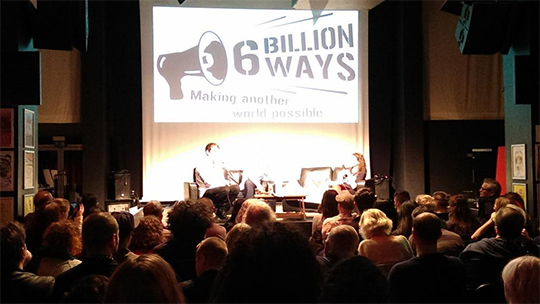
The first of our film nights hosted at Rich Mix explored the concept of food sovereignty through a series of short films and discussions on the problems of the existing global food system and the need for, and viability of, alternatives. With well over 200 people in attendance, this was a fantastic occasion in bringing together a range of food campaigners and global justice campaigners with an interest in the politics of food.

Food sovereignty is a concept developed by La Via Campesina as an alternative to neoliberal policies. It focuses on local agricultural production, access of peasants to land, water, seeds, and credit, and popular participation in determining agricultural policy. More information can  be found in this video by La Via Campesina on food sovereignty. The global campaign for food sovereignty, which is growing in momentum, is therefore a crucial aspect of the fight for social, economic, and environmental justice.

Discussion was animated and thought-provoking and we were fortunate enough to be joined by Kirtana Chandrasekaran, a food campaigner for Friends of the Earth International, and Dan Iles, a local food campaigner in Bristol and a UK delegate to the recent Nyeleni European Food Sovereignty Forum in August. A range of issues were addressed, including the significance of local grassroots action, the relative merits of food sovereignty and fair trade, and the potential of ‘traditional’ agricultural methods.

It was great to hear so much enthusiasm from everyone about getting involved in campaigning on food sovereignty. More information about our organisations’ food campaigns can be found on our respective websites. For those that were unable to attend our event or would like to spread the word about food sovereignty through local groups with similar events, many of the films we screened can be downloaded or viewed online:
 
The Real News report from Honduras


Not a very green revolution


I Eat Therefore I Am


Detroit: Rising from the Ashes


Natabar the seed farmer


Upendra has Worms


Posted in Activism | View Comments

‘People First, Not Finance!’ – November G20 Mobilisation

G20 mobilisationThe G20 summit will take place this year on 3 and 4 November in Cannes and preparations are underway for the ‘People First, Not Finance’ Alter-Forum to be held in Nice from 1 to 4 November. The G20 has a powerful influence on global economic policy and, in the midst of sustained financial crisis and deepening economic austerity, remains a major target for the global justice movement.

Called by various unions and campaigning groups in France and supported by others across Europe, a mass demonstration on 1 November will be followed by days of action and the Alter-Forum. This will include open meetings and debates on the following themes:

  1. End inequalities and austerity: employment, social rights, welfare, and debt
  2. People before the market: financial regulation and debt
  3. System change, not climate change: environment and development
  4. Don’t gamble with our food: agriculture and food
  5. Indignados, rebels, and solidarity: democracy, the Mediterranean struggles, rights and liberties
  6. They are 20, we are billions: global governance.

Details are still in the planning stages and more information will be available soon. Keep checking the 6 Billion Ways website for more updates and details on how to get involved.

For more information, see the website of the French G8G20 2011 Coalition.

Posted in Activism | View Comments

Film night: Reclaiming our food system

6 Billion Ways presents an evening of short films, speakers, music and info stalls.

While a billion people go hungry, hundreds of thousands suffer obesity and food producers in rich and poor countries alike struggle to make a living. The global food system is dysfunctional – but there are solutions. Our evening will explore the idea of food sovereignty, a way of putting both people and the planet first, and challenging the corporate dominance that makes our food system so unsustainable.

We’ll have a series of short films, interspersed with expert speakers and discussion. Then Asian Dub Foundation’s John Pandit will kick up some tunes while you dance, chat or find out more about food justice campaigning.

Tuesday 20 September, from 6.30pm
Ground floor bar, Rich Mix, 35-47 Bethnal Green Road, E1 (googlemap)
Free event, paid bar available

Films

The Real News report from Honduras – A report from Honduras documenting the evictions faced by small farmers and the growing movement of farmers seeking constitutional reform to guarantee a more equal land distribution.

Not a very green revolution – A short film highlighting the problems with India’s ‘Green Revolution’ where unsustainable agriculture has caused environmental problems and driven farmers into debt.

I eat therefore I am –  Critically analyses the workings of the modern global food system and powerfully advocates the necessity of food sovereignty as a solution.

Detroit: Rising from the Ashes – The story of Detroit residents attempting to rebuild and revive their derelict communities through growing their own food in 1,300 urban gardens.

Natabar the seed farmer – The story of farmers like Natabar, who reject dependence on industrial hybrid seeds in favour of saving indigenous rice seeds.

Upendra has worms – A very short film which documents a growing shift back from the use of chemicals to traditional agricultural methods, such as the use of worm-culture in sustainable organic farming.

Speakers

Kirtana Chandrasekaran A food campaigner for Friends of the Earth International, who will talk about the growing global movement for food sovereignty in the context of corporate dominance of the food chain.

Dan Iles Local food campaigner in Bristol, involved in setting up a grocery co-op, and a UK delegate to the European Food Sovereignty Forum in Austria this August, which he will be reporting back from.


Posted in Events | View Comments

6 Billion Ways 2011 – What was it all about?

Saturday 5 March 2011. The day 6 Billion Ways returned with yet more debate, discussion, art, film and performance. Rich Mix and four neighbouring venues were flooded by 1,700activists from across the UK, temporarily transformed into hubs of global justice as the world’s leading thinkers and campaigners knocked heads for a common solution.

The East End has always been the home of progressive social movements, witnessing Keir Hardie and the first steps of a fledgling Labour Party, exiled Jews orchestrating resistance, the defeat of Britain’s fascists, South American revolutionaries taking shelter but never giving up the fight. It’s this spirit that 6 Billion Ways looked to and drew from in facing the multiple crises that are before us: repression of democracy, exploitation of our natural resources and atmosphere, a financial crisis that deepens by the day. The list could go on.

Session after session, film after film, not just problems but also solutions were given the space and time to be discussed and debated.

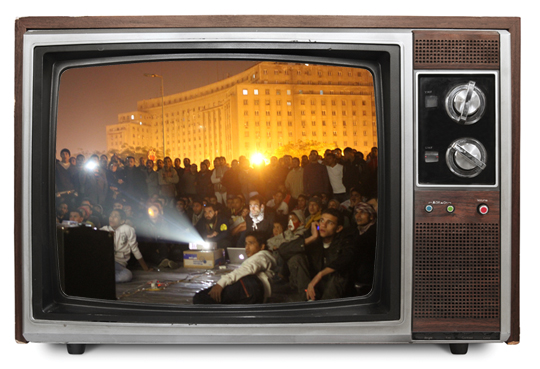
Egyptian activist Gigi Ibrahim brought firsthand experience of what it was like in Tahrir square, Cairo, during the uprising, sharing not only the hope of a better future but the determination that was held by everyone present.

Bolivian ambassador to the UN, Pablo Solon, spoke to 250 people about the need for social participation in the climate debate and the dangerous direction international negotiations are currently taking. At last year’s climate talks in Cancún, Solon was the only person to speak out against the resulting agreement, refusing to ratify a document that would – in the eyes of his government – lead to genocide and ecocide. Remarkably, this was all done via video conferencing and a 20 ft projection.

Practical discussions around fighting the cuts brought grass roots campaigners Michael Chessum (National Campaign Against Fees and Cuts), Jim Cranshaw (Oxford Save our Services) and Anna Walker (UK Uncut) together to talk tactics and alternatives.

Other sessions on consumption, the BDS (Boycott, Divestment, Sanctions) campaign against Israel, the food crisis and endless other subjects achieved similar aims of bringing the debate to the fore and examining solutions. But the real motivation driving the organisers of 6 Billion Ways forward – ultimately what made the event so relevant – was the need to connect these issues. Each is important in its own right, but when examined together, as symptoms of the same problem, it’s possible to see the bigger picture, to identify the drivers and to build a movement that can collectively direct its energy towards tackling them. The prevalence of corporations and their interests over those of citizens emerged from each session; the attitude of governments towards free trade and economic growth at all costs, no matter what the consequence; the ease with which accountability is ignored. Missing in each crisis is a notion of justice, be it social, economic, political or environmental, and it was in the name of justice – global justice – that 6 Billion Ways was convened.

The final rally captured perfectly the spirit that grew throughout the day and the pressing need for action, for movement building and for the fight on our hands as we demand justice. Omar Barghouti, founder of the BDS movement in Palestine, sent shivers down the spine as he delivered the memorable lines “I wish you Egypt so you can, like the Tunisians, the Egyptians, the Libyans, the Bahrainis, the Yemenis, and certainly the Palestinians, shout, “No! We do not want to select the least wrong answer. We want another choice altogether that is not on your damned list.” Given the choice between slavery and death, we unequivocally opt for freedom and dignified life–no slavery, and no death.”

But what is needed now – what has been recognised across the world – is how we build on what we have achieved, how we capture the energy so evident in that hall and channel it; where can it best be used and how can we make that happen? The TUC ‘March for an Alternative’ was a start, and one 6 Billion Ways united behind, but we need to keep building, relying on those that took part and those that support the common cause to keep fighting – not just in the name of our individual interests and causes but for global justice and a, as Omar put so well, “It is time for all the people of this world, particularly the most exploited and downtrodden, to reassert our common humanity and reclaim control over our common destiny.”

Posted in Uncategorised | View Comments

6 Billion Ways volunteering opportunity

We’re currently looking for a volunteer to support ongoing work led by individuals in each of the partner organisations and help to facilitate joint activities. The post holder will look after the 6 Billion Ways website, email list and social media, help with administration and logistics and project managing events.

If you’re a natural organiser looking for experience in a campaigning organisation, we’d like to hear from you.

What we offer

Whilst this volunteer post will be part of a coalition of organisations , the post-holder will work from the offices of the World Development Movement in Kennington, south London. However, there will be the opportunity to work from the offices of the 6 Billion Ways partners from time to time; thus offering an insight into a variety of campaigning organisations.

The post-holder can follow flexible working hours; we would expect one day per week to be spent in the office, the other day could be spent in the office or could be taken during evenings and weekends as would best suit the individual and the role (there will be several events and meetings taking place outside regular working hours).

About 6 Billion Ways

6 Billion Ways is a coalition of organisations (Friends of the Earth, War on Want, Jubilee Debt Campaign and the World Development Movement). In partnership with Rich Mix, we have organised large-scale activist conferences in East London in 2009 and 2011. We are continuing to work together, sharing an understanding of how our organisations can better contribute to building a global justice movement if we work together.

Deadline for applications: 6pm on Friday 8 July

To apply, please send a cover letter and CV to James O’Nions at james@wdm.org.uk.

See attached document below for the role description

Shortlisted candidates will be invited for an informal chat at the WDM office, shortly after the deadline.

Job description

Posted in Uncategorised | View Comments

Stuffed and starved: Reclaiming the global food system

This last session of the day in St Hilda’s was worth the wait, and bleary- eyed activists soon packed out and occupied every available chair and piece of floor space in the venue. This captivating and engaging discussion highlighted the problems caused by the current global food system, and the ways in which we can work together to change it for the better.

Deborah Doane from the World Development Movement clearly and concisely outlined the root problems with the current global food system. She talked about the issue of waste, and rejected the notion that there is not enough food to feed the world, insisting that the problem lies not in food production, but instead in food politics. Deborah dismissed the idea that the remedy lies in injecting more money into food production. She placed the problem in the uneven and unethical disparity of food distribution. While we burden ourselves with health problems from overeating in the West, many other parts of the world are left without enough food to survive; a mind-boggling one third of the food that we produce ends up as waste.

Deborah talked about how we have come to situate ourselves within this dire situation. She pointed her finger at the stripping and replacement of locally-based knowledge with corporate monopolies, who dominate with top-down approaches, and whose vested interest lies in profiting from the market; instead of ensuring people all over the world have enough to eat.

Next up on the panel was Kirtana Chandrasekara, who spoke of the illusion of control and choice in food we buy in shops and supermarket. In the West at least, we are made to believe that we have free choice of what’s in our diet, when in fact most food we buy contains the same four components: salt, fat, sugar and soya. She talked about the ‘commodification of life’ and the continuing battle against corporations not only in ownership of global food networks, but now also now in green energy. She stated that the crisis that currently exists in the food sector is down to the same conditions that have caused the crisis in the financial market: deregulation.

Kirtana went on to outline the problems with the increasing financialisation of the global food system, highlighting its inherent flaw of putting profit before people. This factor has manifested itself in areas such as community isolation and poor pay. She then spoke of what is being done at government level to combat this travesty and drew attention to Malawi, who rejected the forced liberalisation of their food production by heavily subsidising farmers and investing in small-holder production, resulting in greater food security and ensuring the safety of farmers’ livelihoods. She talked about what is happening at the grassroots level, giving the example of Egypt, and urged people to recognise current revolutions of small scale farmers in reaction to corporate domination. She stated that the greatest example of this is the fight against global seed sales, where only ten companies dominate two thirds of the market, and where 80% of GM seed sales are owned by multinational corporation Monsanto. This effectively means that, due to a lack of competition, companies have come to be able to charge what they want for seeds which people rely on for survival. This has resulted in a 50% price increase in the last ten years. While people become increasingly desperate and pay more for seeds, companies see record profits.

Kirtana extended the notion of monopolistic control to Bio-tech companies, and the central problem of research results. Again, a lack of real competition has led to a narrative which, instead of representing scientific objectivity, actually just represents corporate interest.

As an alternative to the problems highlighted, Kirtana suggests the Food Serenity Movement. This is a system based on feeding people before profit; it is a movement spreading across the world, helping to disable the genocide of small farmers. Small land holders still grow 70% of food produced in the world, and an astonishing three quarters of that food produced is outside of corporate control. The food Serenity Movement seeks to put the control of food back into the people’s hands by introducing local food systems, giving people what they want, and rebuilding local knowledge and skills that have been stripped by corporate control. This is not only a movement for farmers, but a movement for us all in being able to combat corporate-led capitalism.

Last up on the panel was Patrick Kroeser, a representative from Crofters in Scotland, who he says are the last organised groups of peasants in the UK. Patrick spoke of how before industrial agriculture the land was managed by crofting, which is the traditional system of land tenure. He talked of the importance of supporting Crofters and the negative impact that industrial agriculture has had on not only the land, but also on community life.

Patrick also criticised the destructive element of de regulation; seeing the problem as originating in the post-war period when people were forced to become self sufficient from the land. Due to lack of regulations, landlords were able to kick people off their land when they were able to make greater profits elsewhere, disregarding people’s rights to their means of production.  Patrick also publicised the organisation Naviar Compassion, a movement that is part of Food Serenity, which seeks to reclaim food production whilst helping to maintain communities and protect the environment.Patrick called for a reduction in the $60 billion a year support for industrial agriculture, and for greater subsidies to support small-hold farmers. He appealed to members of the public to be part of the change, by being aware of what your buying, buying local food or even better growing your own, and reconnecting with food production.

The unifying narrative that drew all three of these dynamic and interesting speakers together was the fact that we need to retake control of our food system, in a concerted and coordinated effort to put people, not profit, first.

Posted in Uncategorised | View Comments

6 Billion Ways – Keeping up the momentum

The day after the main 6 Billion Ways event, we held an open space session at Toynbee Hall on building the movement for global justice.

The meeting used open space facilitation, which meant that the agenda was constructed by the people who came based on what they wanted to discuss, and people were free to move around to different discussions at any point. About 60 people came, most of whom had been the previous day. Many more made excuses based on too much partying the previous night…

Hot topics
There were a variety of issues raised, from carbon trading to housing, fixing the financial system to what UK Uncut should do next, and what to do about arms company Lockheed Martin running the census. One of the most popular discussions was about plans for the 26 March anti-cuts demonstration in London, which led to a callout for a national day of publicity for the demonstration on Saturday 19 March, on high streets and on Facebook and Twitter (use #March26 #whyiammarching #demo2011).

Keeping up the momentum
Another popular session was on ‘Keeping up momentum after 6 Billion Ways’. As one of the organisers of 6 Billion Ways, I was particularly interested in this one. So far 6 Billion Ways has been an event we’ve held twice to bring together lots of different strands of the movement and encourage cross-fertilisation to make it stronger. But this session indicated an appetite for more than that. Some of the suggestions that came up in the session were:

  • Holding 6 Billion Ways once a year not every two years (the first event was in 2009)
  • Regular meet-ups in London every two or three months. These could be public meetings in the manner of the sessions at 6 Billion Ways or open-space sessions like the Sunday event.
  • Organiser training for global justice activists around the country, perhaps with a focus on making links between issues and networks as at 6 Billion Ways
  • A web portal where people can find out about global justice campaigns, including being able to filter by region and issue. Like False Economy but not just on the cuts. It could be a list of existing campaigns and maybe aggregate from other sources like Google News.
  • More co-ordination at national level between all global justice organisations, so that people feel part of something bigger (Make Poverty History, Stop Climate Chaos and Put People First were examples of where this has been/is being done before, in different ways)
  • Using the 6 Billion Ways Facebook page to build up a network of global justice activists and discuss the issues raised. Also perhaps to identify some priority global justice issues for people to work on together

What do you think?
Some of these things, or things along the same lines, may be happening already, but not everyone might know about them. Some of them might not be useful, and some of them might be easier said than done!

As the 6 Billion Ways organisers we’re thinking about what we do next, and we want to know what you think. So let us know in the comments.

Posted in Activism | View Comments

Biosphere crisis provides single channel for humane organisations

Some thoughts evoked by 6 Billion Ways 2011:

Deep ecologist, monk, and all round wonderful man Thomas Berry (1914–2009) reminded an audience in 1991 of something with which we’re all intimately familiar, nothing less than the unifying Golden Rule, which has probably been around as long as we have, certainly predating many of the recent mainstream religions–Berry’s own Catholicism, etc–with which one might be quick to associate it. Berry put it thus:

“Confucius was a teacher and, naturally, did a lot of talking. His students got a bit overwhelmed with what he was saying, and so they got together with him one day and said, ‘Could you please put it to us more simply?’
And Confucius said, ‘Sure, why not. I’ll give it to you in a single word – reciprocity.’
What’s it all about? Reciprocity – if you take, you must give. That is the primary law of existence.”

Susan George (who graced Rich Mix in 2009) has articulated the need for greater, concentrated unity and the (re)establishment of “the Superpower that the New York Times said on the 16th February [2003] we were”, referring to the unprecedented, extraordinary global peace marches that greeted Bush-Blair’s plan to invade Iraq for oil and U.S. regional domination. Unfortunately the awesome sight proved a mere reminder of the Superpower, which promptly went back into hibernation.

In her latest book, George defines the issue facing us. We have allowed the casino economy of finance to become central. The real economy takes second rung, society next, and finally, least important, is poor old planet Earth. George–crazy as it may sound–suggests the only way forward (as in, to survive) might be to reverse that order.

The follow-up session for 6 Billion Ways attendees took place Sunday 6th and was stimulating and informative. It was striking how plain straightforward most ideas were, highlighting a distinct absence of any crazy or overtly unworkable plans to improve the world. Most seemed derived from a rather common sense of decency and values. I had the pleasure of chatting briefly with Nick Dearden afterwards and we agreed on that same point, that there’s nothing outlandish about being reasonable, nor asking it of others. There’s nothing radical, left or right, about compassion.

As for the outstanding sessions of March 5th, of which there were many, this writer must nonetheless confess to having peaked in the AM at first session What is Climate Justice?, chaired by Kirsty Wright, with Patrick BondRicardo Navarro and Larry Lohmann, all of whom shared so generously from their abundant knowledge of global climate affairs, and no doubt left the audience thoroughly unsettled by the end of the session. Lohmann’s work has specialized in the appalling phenomenon of carbon trading, whereby the financial sector capitalizes on the same particles known to be leading to global upheaval and mass-extinction. Needless to say, such practices represent some of the darker reaches of our species. And yet how unsurprising such profiteering has become. Capitalism causes it, then cashes in on it. Nature of a manmade beast.

Thanks to the organizers and participants who made 6 Billion Ways so memorable this year. Special thanks to that fellow concerned citizen encountered between sessions, who put it so trenchantly when she identified the single common value of everyone assembled for 6BW 2011 as being “anti-greed”. Catchy, and soon it clicked that anti-greed is a simple definition of reciprocity, the primary law of existence. How radical.

Posted in Uncategorised | View Comments